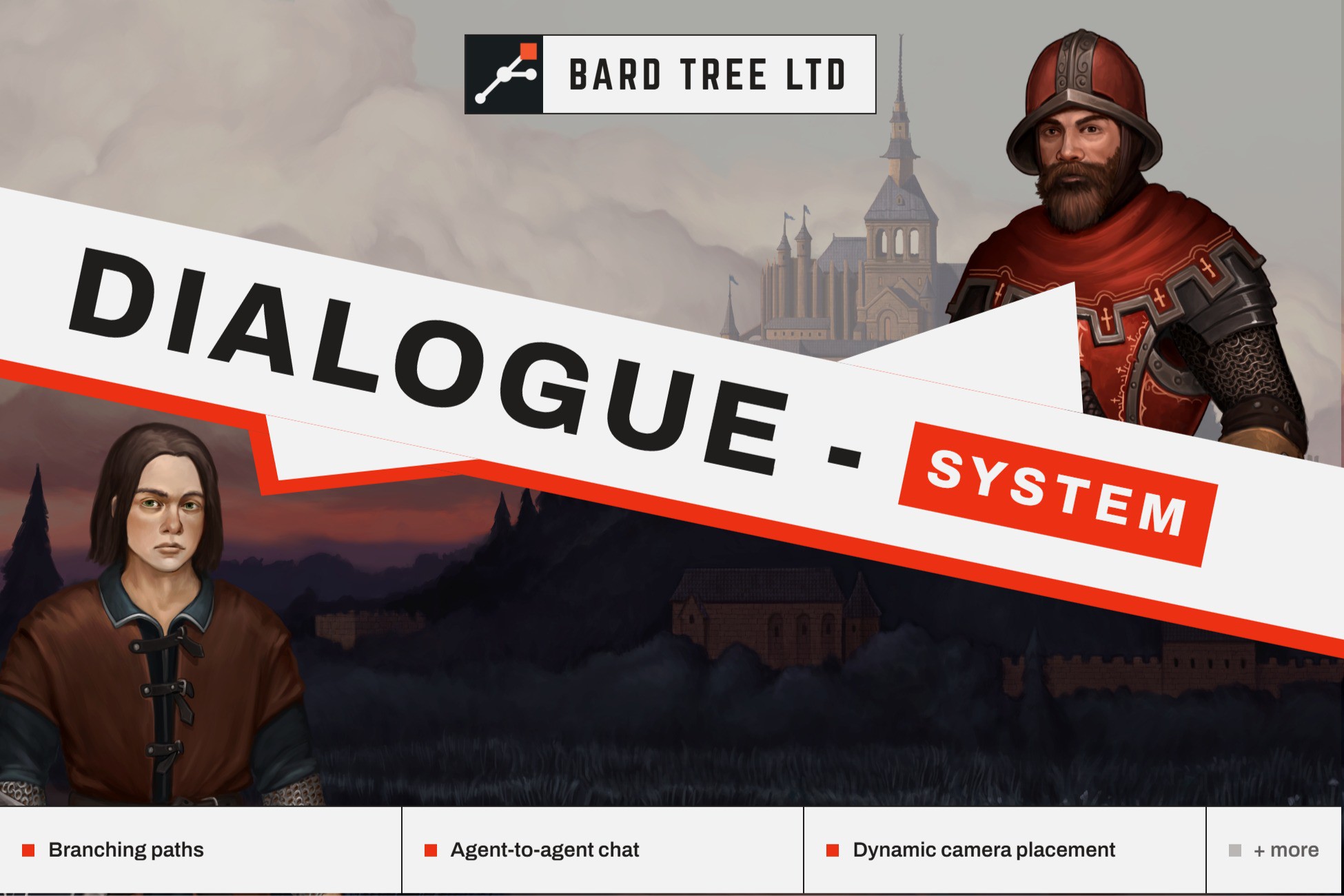
DIALOGUE-SYSTEM is designed to allow anyone to create complex diagloue for their projects; be the Open World RPGs, narrative driven games or simulations. No need to code, easy setup and endless possibilities.
Documentation | Discord
This works great and out of the box with CIVIL-AI-SYSTEM, having both allow for no code deep detailed scenes to support your imagiation and project.
World Class Support
Never alone when using CIVIL-AI-SYSTEM, any problems feel free to reach out on discord and it will get sorted and advice will be given if wanted. The wiki also provides guides, interfaces and a host of other useful features to help you get the most out of this tool.
Endless Integrations & Extensions
As it been developed with best practices it is easy to extend and expand at ease! Most systems have interfaces and separated concerns meaning easy switching out of parts. Gives you the user the freedom to extend and change as you see fit with minimum merge conflicts between versions. There are also supported integrations out of the box.
Supported Integrations (No Code changes)
- uLipSync
- CIVIL-AI-SYSTEM
- Cinemachine
Writing dialogue
- Two ways to write conversations — a visual drag-and-drop node graph for people who think visually, and a plain-text script format for people who'd rather type. Both complete systems so choise whichever one suites best
- A dedicated text editor with spellcheck-style error highlighting (missing links, dead ends, duplicate names) and autocomplete, so writers never have to touch the node graph if they don't want to.
- Reusable conversation "pieces" — a line of dialogue can bundle text, a sound clip, an animation, a mood/emotion, and a camera instruction together.
- Conversations can call other conversations, like a function call — jump to another tree and come back to exactly where you left off. Allows you to build more complex systems without having to repeat yourself.
How a conversation plays out
- Two conversation modes: one where the player looks at an NPC and talks directly, and a separate "background" mode where two NPCs can have a conversation with no UI popping up — allows your NPCs to bring even more life into your scene.
- Smart pacing — a line can wait for a button press or auto-advance after a set time (with a visible countdown), and timing is calculated automatically from how long the voice line or animation actually takes.
- Never gets the player stuck — if a conversation would end with no valid options, it automatically recovers or closes gracefully instead of freezing. In the editor it also provides a warning for easy debugging.
Branching choices & logic
- Real "if this, then that" logic — gate a line or option behind conditions, and combine multiple conditions with AND, OR, and NOT, nested as deep as you like (e.g., "show this option if the player has the key AND [it's night OR the guard is asleep]").
- A built-in library of conditions: whether the player is carrying a specific item (or enough of it), what time of day it is, and values stored in a shared memory system.
- A "memory" system for NPCs and the player — the game can remember facts like "already met this NPC," "reputation level," or "quest flag set," and dialogue can read or write it.
- Whole conversations can swap based on story progress — an NPC has one conversation before a quest and a different one after, picked automatically.
- Token index system — Put placeholders in text and have them replaced with values during conversation from a series of different systems.
Multiple languages
- Built-in translation support for text and voice lines — write dialogue once, then a tool automatically finds every line in the game and builds a translation table for translators to fill in.
- Language can be switched at runtime — ready to be wired to a settings-menu language picker.
Camera & cinematics
- The camera directs itself — it automatically picks shots like a film editor: an establishing shot when a conversation starts, over
Description sourced from the Unity Asset Store listing.