Live Demo (desktop browser with WebGPU)
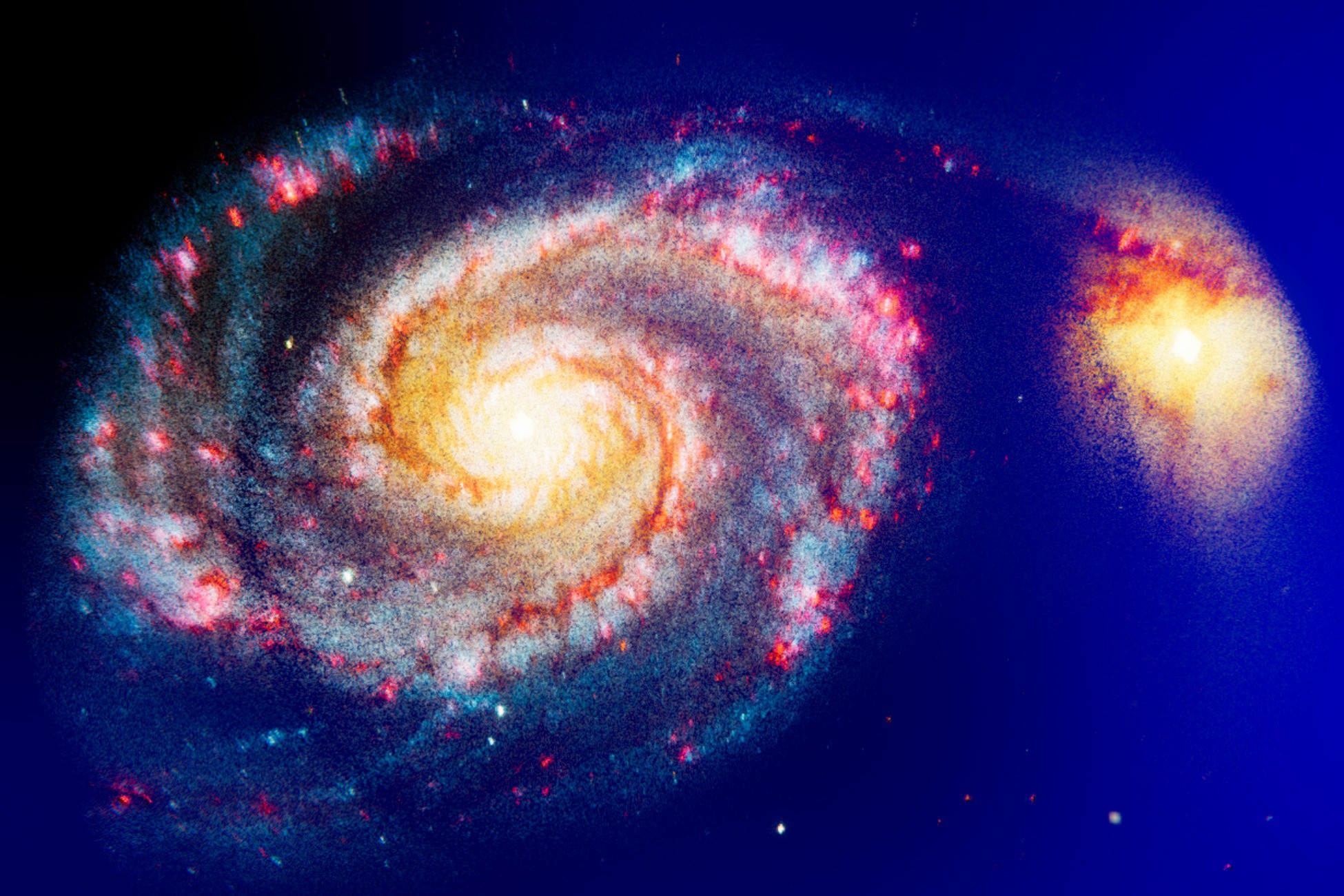
Transform your Unity projects with scientifically grounded galaxies rendered in real time. Galaxy Constructor generates a million stars and more with GPU compute shaders and draws them in a single draw call, delivering cosmic environments for space games, simulations and cinematic scenes. Version 3 makes every star a place you can visit.
- Real Telescope Data: Use astronomical images from Hubble, Spitzer or WISE. A density map and a color map made from the image set the shape and colors of the galaxy. Or design alien galaxies with your own density maps and color palettes.
- Power Meets Simplicity: Adjust star density, brightness and scale in the Inspector while the game runs and watch the galaxy rebuild. The same live preview works in the Editor outside Play Mode. No coding and no shader setup for the basic workflow.
- Endless Possibilities: From a classic spiral to an irregular or colliding pair, any image becomes a galaxy. Change the seed for a new variation, keep it fixed for a stable map.
- Every Star Is a Destination: Click a star and it gets a spectral class, physical parameters, a name and a planetary system with moons, asteroid belts and comets. The record goes to a CSV database and appears on an info card. The Jump button flies the camera to the star and opens its system.
New in Version 2.0
- Star selection by mouse click or touch
- Procedural star data: spectral and luminosity class, temperature, luminosity, radius, mass, age, metallicity
- Old and young stellar populations mixed by position: the bulge and halo lean old, the disk leans young
- Catalog names by galactic sector and proper names for bright giants
- Planetary systems built from your own Body Type assets and prefabs
- CSV database of visited stars
- UI Toolkit info card, camera flight and a demo star system view
- Galaxy Settings asset: one galaxy in one file, swappable from the Inspector or a script
- Near Rays: lens style diffraction rays on bright stars close to the camera
Data That Matches the Picture
Star data follows what the player sees. Blue regions of the color map give hot stars, red and orange regions give cool ones, and a large bright star is more likely to be a giant. Brown dwarfs, white dwarfs, neutron stars and black holes appear alongside normal stars, and every chance is editable.
Deterministic
The same Galaxy Settings asset gives the same stars, names and planets on every run. Each system and each body carries its own seed for your own content: surfaces, resources, missions. Visited stars are read back from the database, so tuning the tables later does not change a map your players already know.
Performance
Stars are camera facing quads read straight from a GPU buffer: no GameObjects, no geometry shader, one draw call for the whole galaxy. Star data is generated only on click, and picking among 300,000 stars takes 1 to 2 ms in a build. Metal, Vulkan, mobile, consoles and VR are supported.
Full C# and HLSL source code, a demo scene and detailed documentation are included.
Also you may like Digital Planets for planets shaders
Description sourced from the Unity Asset Store listing.