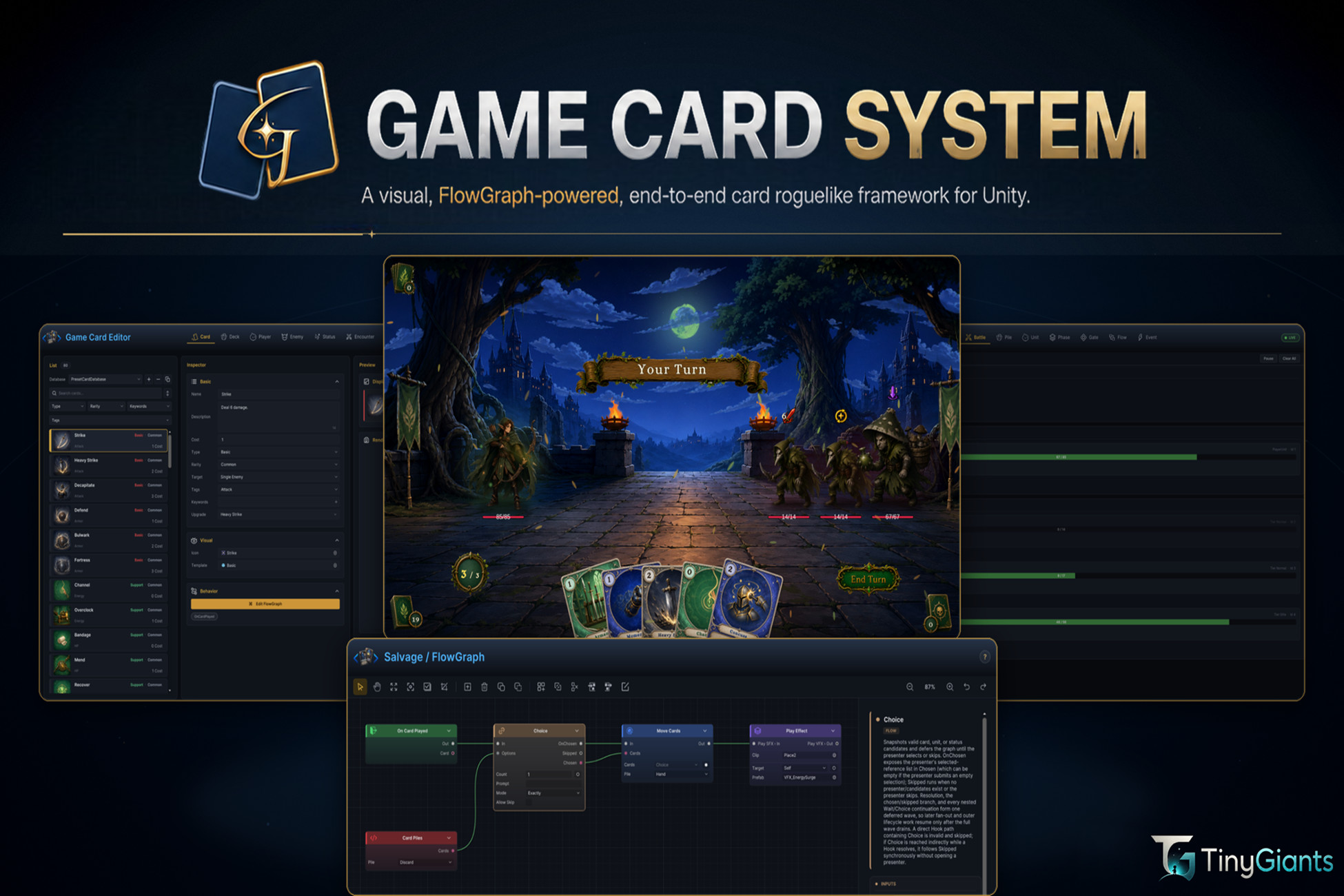
Create Content Visually and Build Complete Card Roguelike Battles with FlowGraph
Official Website | Documentation | Video Tutorials | Discord | Unity Forum
Game Card System (GCS) is a visual card roguelike battle framework for Unity. It combines content authoring, FlowGraph-based gameplay design, a complete battle runtime, Play Mode diagnostics, and C# extension APIs in one workflow.
Create cards, decks, players, enemies, statuses, and encounters without rebuilding turns, energy, targeting, piles, status resolution, enemy Intents, rewards, or battle results for every project. The same assets and Behaviors edited in GCS are executed by the production runtime and can be inspected while the battle is running.
🚀 Core Features
- Game Card Editor provides Card, Deck, Player, Enemy, Status, and Encounter modes in one window. Create, search, filter, sort, preview, validate, and inspect references with Undo/Redo support.Six-Mode Visual Content Editor
- Cards, Statuses, and Enemies each own a FlowGraph Behavior. A complete Demo installation provides 147 available nodes for damage, healing, Armor, Energy, card movement, targeting, calculations, branches, loops, Hooks, enemy Intents, events, VFX, SFX, animation, and waits. Build common mechanics by connecting nodes instead of creating a new C# type for every card.FlowGraph Gameplay Authoring
- Start from 52 card recipes, 30 status recipes, and 21 enemy behavior recipes. Each recipe documents its node connections, configuration, and runtime boundaries, giving you a tested structure to adapt and balance.103 Documented Mechanic Recipes
- GCS manages Battle Start, player and enemy phases, Battle End, Energy, targeting, Draw, Hand, Discard, Exhaust, Master Deck, status stacks and decay, Hooks, delayed effects, summons, player Choices, rewards, permanent upgrades, cost changes, Gates, victory, and defeat.Complete Battle Runtime
- Statuses can combine stacking, decay, numerical modifiers, Hook interception, and independent Behaviors. Hooks can modify or cancel damage, healing, Armor, Energy, drawing, card play, status application, and maximum hand size before results are committed.Status and Hook Systems
- Build enemy behavior with Sequence, Weighted Random, HP Threshold, Once Per Battle, and Every N Turns patterns. The HUD previews the next Intent, while the runtime preserves pattern state and supports enemies entering or leaving battle dynamically.Previewable Enemy Intents
- Game Card Monitor provides Battle, Piles, Units, Phase, Gate, Flows, and Events views. Inspect live state, FlowGraph execution, wait sources, pile changes, and event history when a mechanic produces an unexpected result.Real-Time Battle Diagnostics
- GCSApi is the public entry point for battle control, state access, content discovery, and event subscription. GCS includes 43 built-in events, four automatic extension registries, seven custom node base categories, complete source code, copy-ready templates, and runnable examples. Connect custom UI, maps, quests, save systems, or project-specific mechanics to the same runtime.Open C# Extension APIs
🧩 Built for Structured Content Production
GCS was created while developing a production card roguelike, where interactions between costs, targets, piles, statuses, Hooks, Intents, UI, animation, and waits had outgrown scattered control scripts. Its shared data model and runtime make those dependencies visible and testable, so iteration can stay focused on mechanics, balance, and player decisions.
GCS does not include or require an AI model. If you use AI agents, the six databases, FlowGraph structure, Validation, GCSApi, and Monitor provide clear boundaries for tasks such as:
- Creating and configuring content entries
- Assembling or modifying FlowGraph Behaviors
- Tuning values and class builds
- Checking references and configuration errors
- Diagnosing issues from runtime records
The resulting assets remain editable, inspectable, and under the developer's control.
Description sourced from the Unity Asset Store listing.