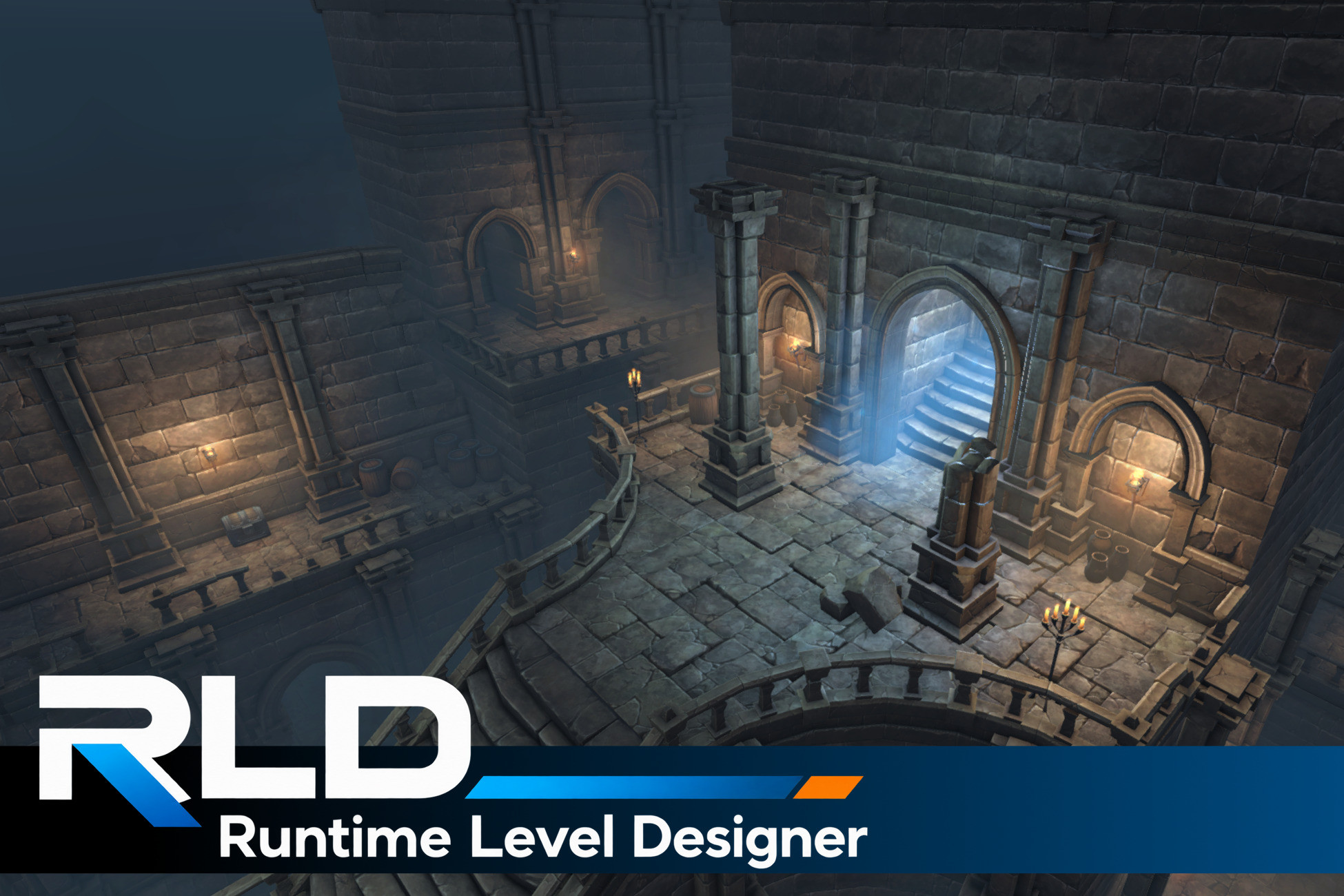
RLD is a complete runtime level-authoring framework for Unity, built for runtime level-editing applications, sandbox construction systems, user-generated-content workflows, and dedicated level-design tools.
Instead of assembling separate runtime gizmo, snapping, placement, hierarchy, prefab, UI, Undo/Redo, and persistence systems, RLD provides them as one integrated editing environment.
From modular construction and surface placement to paths, volumes, scatter painting, retained curves, runtime inspection, and editable scene documents, RLD provides the foundation for building serious runtime level-design tools.
🛠️ Looking for level design inside the Unity Editor?
Check out GSpawn – Level Designer, a powerful level-design plugin built directly for the Unity Editor.
⠀
📷 Trailer
📖 Documentation
🎮 Downloadable Demo
Tutorials
▶ RLD Tutorial 1 - Setup & UI overview
▶ RLD Tutorial 2 - Modular Environments I (Basics)
▶ RLD Tutorial 3 - Modular Environments II (Modular Actions)
▶ RLD Tutorial 4 - Modular Environments III (Spawn Actions)
▶ RLD Tutorial 5 - Outdoor Environments I (Props Spawn)
▶ RLD Tutorial 6 - Outdoor Environments II (Curve Spawn)
▶ RLD Tutorial 7 - Outdoor Environments III (Scatter Brush)
▶ RLD Tutorial 8 - Object Groups
Purpose-Built Runtime Level Design
RLD goes beyond a generic runtime editor by providing dedicated workflows for constructing levels.
Build modular structures, place props directly on surfaces, create repeated layouts along paths, fill grid-aligned volumes, paint scattered content, and author retained Catmull-Rom curves that remain editable after creation.
All of these systems share the same selection, prefab identity, Object Groups, scene queries, Undo/Redo, hierarchy, configuration, shortcuts, and persistence infrastructure.
⠀
Runtime Authoring Environment
RLD includes a complete dockable runtime workspace with:
- Hierarchy View
- Runtime Inspector
- Prefab Manager
- Object Groups
- Dockable and floating windows
- Saveable workspace layouts
- Runtime settings and configurable shortcuts
- Style customization
- Runtime Console
- Integrated runtime Undo/Redo
- Dedicated Erase tools
- Runtime creation of supported primitives, lights, audio objects, cameras, empty objects, and Object Groups
Selection and Editing
RLD supports:
- Single and multi-object selection
- Rectangle Selection
- Selection Path
- 3D Selection Box
- Grid-level selection
- Select Connected
- Select Similar Prefabs
- Isolation and Restore
- Configurable selection filters
- Prefab replacement
- Selection Bridge
- Group rotation
- Non-destructive transform randomization
Direct manipulation tools include Move, Rotate, Scale, TRS, Box Scale, Extrude, and Mirror, with configurable Pivot/Center and Global/Local transform spaces.
⠀
Snapping and Placement
RLD provides several specialized snapping workflows:
- Grid Snap for modular construction
- Modular Snap with optional Grid Climb
- Surface Snap for placement against scene geometry
- Box Snap
- Vertex Snap
- Projection
Each system is designed around a different level-design task rather than forcing every placement problem through one universal snapping mode.
⠀
Spawn Tools
RLD includes dedicated runtime spawning workflows:
- Modular Spawn — fast modular construction
- Props Spawn — surface-based prop placement
- Path Spawn — repeated placement along authored paths
- Box Spawn — grid-aligned volume construction
- Scatter Brush — spacing-aware prefab painting
- Curve Spawn — retained Catmull-Rom curves with generated content
Spawn Mirror can reflect Modular, Path, Box, and Props output through one or more construction planes while preserving the normal spawning workflow.
⠀
Procedural Authoring Systems
RLD also includes higher-level authoring systems:
- Random Prefab Profiles for weighted prefab variation
- Cell Layout Providers for procedural Path and Box layouts
- Modular Actions for reusable modular construction behavior
- Spawn Actions for reusabl
Description sourced from the Unity Asset Store listing.