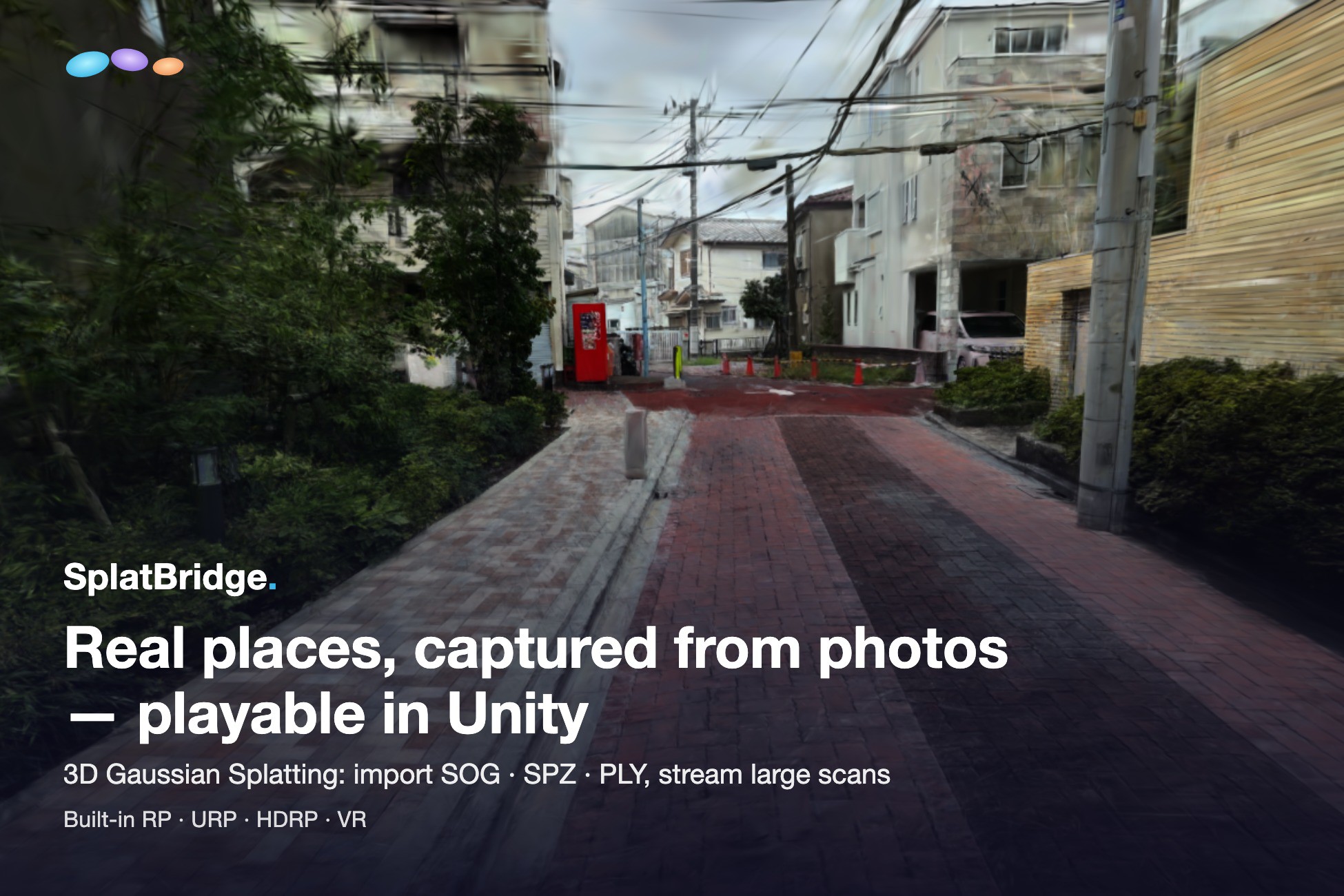
Bring real places into Unity with 3D Gaussian Splatting: explorable scans
reconstructed from photos. Drop in a .sog, .spz or 3DGS .ply, add collision
and gameplay, or take it to VR. Built-in, URP and HDRP are supported. Large
captures stream under a fixed GPU budget — city-scale scans included.
📖 Full manual, troubleshooting table and tuning guide ship inside the
package, in English and Japanese. 🎬 Demo video in the gallery above. All gallery images are unedited in-Unity captures.
💬 Support: publisher contact on this page.
## Import: one step, three formats
**SOG** (PlayCanvas / SuperSplat), **SPZ** (Niantic, v3 gzip and v4 NGSP+zstd)
and **3DGS PLY** (SH degree 0–3). Drop a bundled .sog, .spz or .ply into your
project for a render-ready GaussianSplatAsset — no external converter, no
command line. An unbundled SOG (meta.json plus its WebP files) imports through
an editor menu instead, in the same one step. superspl.at datasets import as
they are; to build a streamed SOG from your own .ply, use PlayCanvas's free
splat-transform CLI (one command, in the README), then bake it in the editor.
## Rendering: every pipeline, correct compositing
- **Every render pipeline.** Built-in, URP (Unity 6 Render Graph, with
Compatibility Mode fallback) and HDRP (Custom Pass). Shaders ship inside the
package and are included in player builds automatically — no "Always
Included Shaders" setup.
- **GPU depth sorting.** A radix sort in compute re-sorts the draw order as
the camera moves, never on the main thread, with an automatic background
CPU fallback where compute sorting is unavailable (specifics under
Technical details).
- **Render scale.** Draw splats into a downscaled offscreen target and
composite: fill cost drops roughly with scale², UI and geometry stay full
resolution. XR has a stereo-array version of the same lever.
- **Correct compositing.** Splats depth-test against your scene, so scanned
content sits behind walls and props instead of floating over them.
- **View-dependent color.** The capture's SH bands 1–3 are evaluated per
view, so gloss, glass and wet surfaces shift with the camera as recorded;
switchable per object. In 1.0.4, Training color mode is the default for
Linear projects; Legacy mode preserves the previous rendering. Far-field
billboard baking now retains SH color and refreshes when SH settings change.
## Streaming: city-scale under a fixed budget
Large captures do not fit in GPU memory, so SplatBridge streams them under a
**hard resident-splat budget** you set once. If all finest full slices fit after
page rounding and transition reserve, full detail stays resident automatically.
Otherwise screen-space LOD adapts within the same cap.
- **No per-dataset tuning.** Quality is judged in screen space, not by
distance: the one quality knob, **Splat Quality Pixels (τ)**, means the
same thing on a tabletop scan and on a city. It ships at a fixed **2 px on
every platform**, so one scene ships to desktop, PCVR and Quest alike; an
optional **Auto** preset resolves it per platform instead, letting mobile
trade detail for fill automatically.
- **Coarser, never holes.** The plan pays for every cell of the dataset before
spending anything on detail, so an under-sized budget is absorbed by drawing
the scene **coarser**, not by dropping parts of it.
- **Know before you ship.** The bake log and the inspector report a **coverage
gate** verdict up front: a budget too small even for the cheapest complete
view is caught in the editor, not discovered on device. An optional debug
log prints coverage, achieved quality, the error distribution and the
frame-time knee, so tuning is measurement rather than guesswork.
- **Fixed memory.** Max Resident Splats is a hard memory cap and the main
performance lever — τ sets quality. The GPU buffer is allocated once at
that size, with per-frame upload budgets, frustum culling and no-flash
chunk swaps.
- **Pre-baked, so the runtime never decodes.** A
Description sourced from the Unity Asset Store listing.