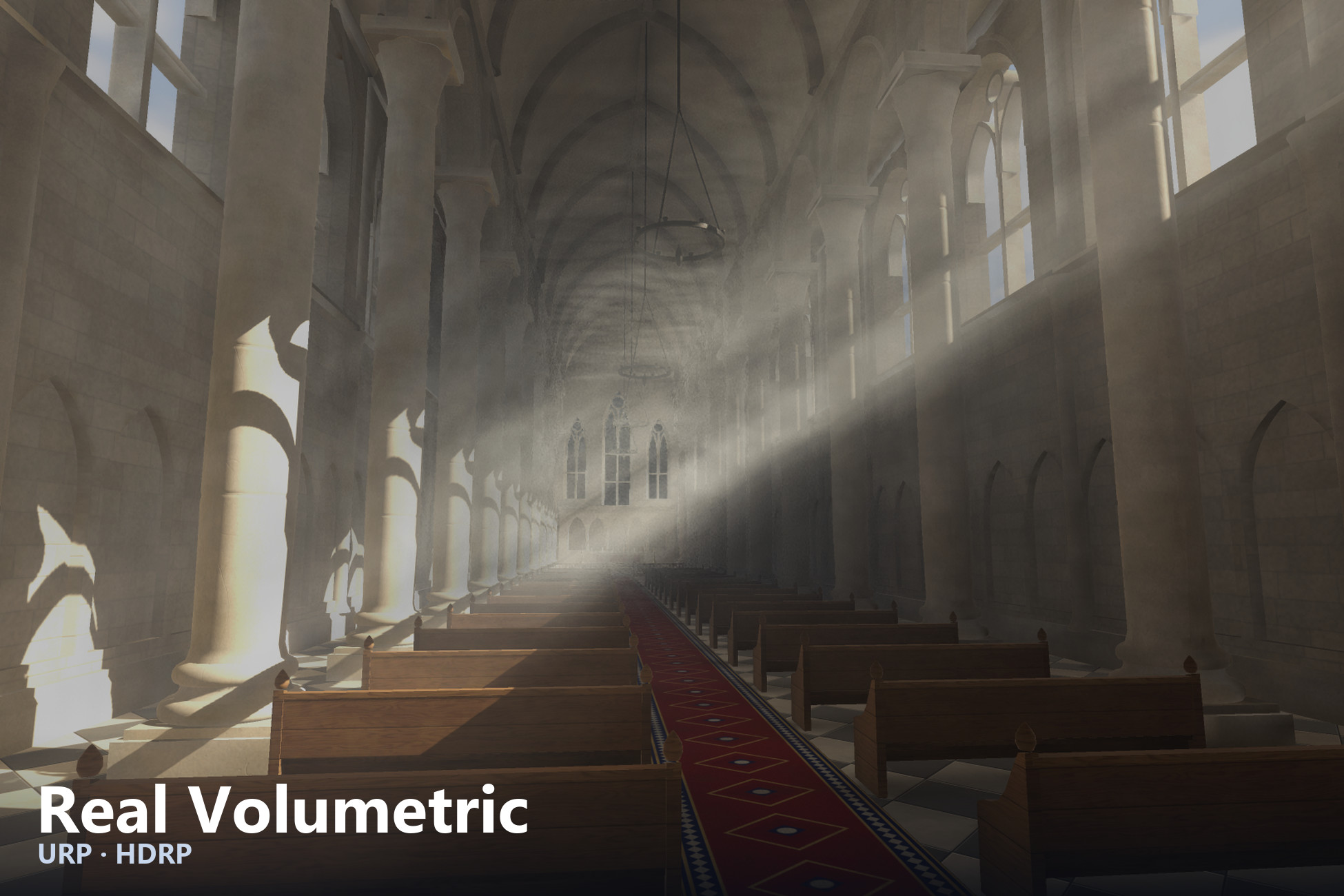
Real Volumetric adds ray-marched volumetric fog, shadowed god rays and fog volumes you place in the editor to Unity 6 (6000.3.21 or newer) in URP, with HDRP supported from the same package. Drop a fog volume into the scene and the fog is there: rolling banks, drifting wisps or patchy mist that move, change form and catch your sun.
Fog only where you put it. GameObject > Volume > Real Volumetric Fog Volume places a box of fog where the Scene view is looking. Drag a face and the fog fills exactly that box and nothing outside it, while the opposite face stays put, like a collider. Every fog volume has its own density style, shape size, coverage, edge sharpness, erosion, gaps, drift and evolution, and one click switches its style. It needs no setup: the menu installs the renderer feature if it is missing, and a volume renders on its own, sunlit and shadowed, with no profile at all until you want global fog or a profile to tune. Boxes and spheres, Add or Max blending, and Subtract to carve clear air out of the weather: a doorway, a cockpit, the inside of a building. The march spends its steps inside the volumes a ray crosses, so a small volume far away is not lost, and with no global fog a ray that crosses no volume costs nothing.
Fog that is not a flat fill. A baked 128³ 3D density texture gives three styles: Rolling Banks (billowing banks with clear air between them), Drifting Wisps (long streamers that curl and re-form) and Patchy Mist (separate puffs hanging in clear air). You can also bring your own Texture3D. Coverage is literal: the texture is histogram-equalised, so 0.4 means 40 % of the air holds fog. The shapes drift with the wind and change form while they drift, because a domain warp moves them instead of a scrolling texture. Self Shadow lets every bank shade itself from the sun: its lit side glows and its core darkens. The same styles shape the global height fog too.
Shafts that are real. In URP the march reads the main light's own cascaded shadow map, step by step, and the shafts fade out towards URP's shadow distance the way URP's own shadows do. HDRP gives a custom post process no cascades, so there the effect renders its own sun shadow map. Window frames, columns, arches and branches cut the light into separate beams instead of a flat glow. A screen-space sun-shaft layer rides on top and works even without a shadow map. Dispersion, off by default, splits every beam into colour at its edges, as if the light came through cut glass.
One switch for performance, with measured costs. Performance, at the top of the profile, sets steps, march resolution, temporal smoothing, budgets and beam shadow size together: Mobile, Low, Balanced, High, Ultra or Cinematic. It never touches the look, and RealVolumetricAPI.SetPerformance switches it at runtime. Measured GPU time of the fog pass on an RTX 4090 in a URP player at 1920x1080: Mobile 0.10 ms, Low 0.20 ms, Balanced 0.77 ms, High 0.98 ms, Ultra 1.40 ms and Cinematic 14.5 ms (for stills and trailers). At 1280x720: 0.06 / 0.12 / 0.40 / 0.65 / 1.05 / 4.66 ms. Mid-range GPUs and phones are not measured yet. When the camera runs TAA, the effect's own temporal accumulation steps aside automatically.
No compute shaders. No VFX Graph. No particle systems. One ray-marched pass at full, half or quarter resolution with a depth-aware upsample. That is why one package covers URP and HDRP, and why the URP shaders also cross-compile for Vulkan, Metal and OpenGL ES 3.
Lamps whose beams stop at walls. Add Real Volumetric Light to any point or spot Light and its beam appears in the fog. Lights can render their own shadow maps (one for a spot, six cube faces for a point light), so a beam is cut by real geometry, including geometry behind the camera. A spot light's cookie patterns the beam itself.
Fog on glass, water and particles. A fullscreen fog cannot fog what is not in the depth buffer, so the same march ships as an include your own shaders call in one line. It comes with a Shader Graph Custo
Description sourced from the Unity Asset Store listing.